
S Corp vs. Sole Proprietorship: Tax Guide for Consultants
 Client Operations Coordinator
on
August 14, 2026
Client Operations Coordinator
on
August 14, 2026
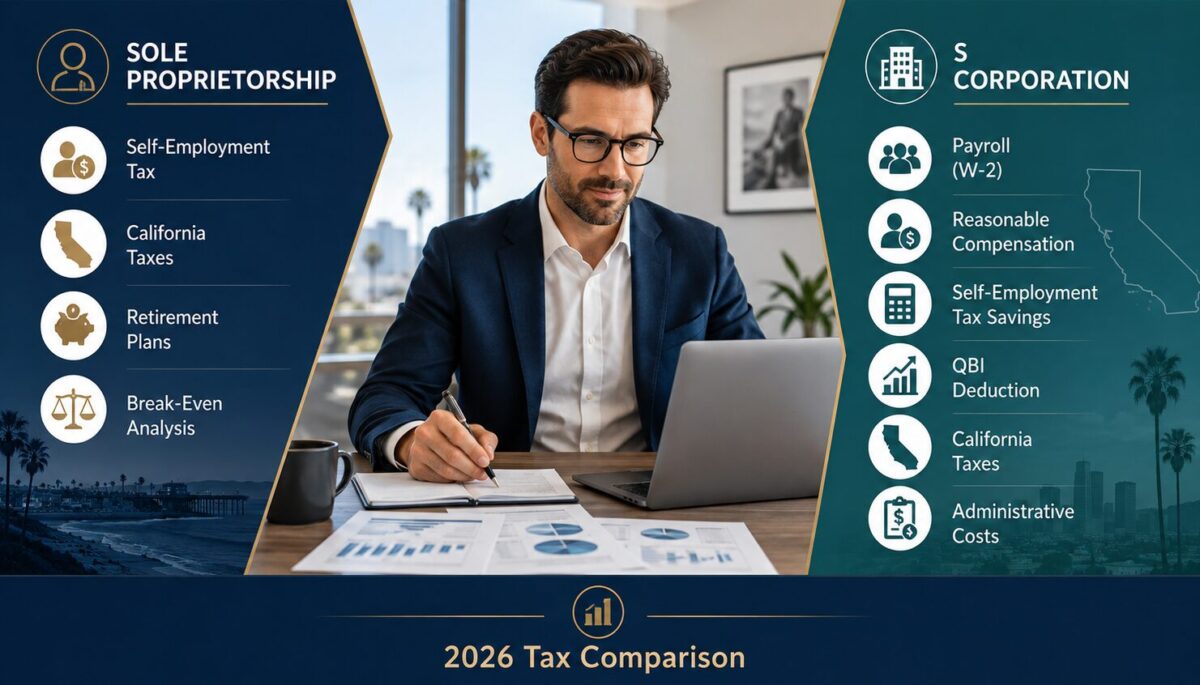
Compare an S corporation vs sole proprietorship for consultants, including taxes, reasonable compensation, QBI, California taxes, retirement planning, and costs.
An S corporation may offer potential payroll-tax savings, but it also comes with additional requirements and expenses. A sole proprietorship is generally simpler to manage but may result in more income being subject to self-employment tax.
Here are the key factors consultants should consider before choosing a business structure.
Sole Proprietorship vs. S Corporation
Sole Proprietorship
A sole proprietor generally:
-
- Has fewer administrative requirements
- Reports business income on Schedule C
- Pays self-employment tax on qualifying earnings
- Does not receive a W-2 salary from the business
S Corporation
An S corporation generally requires the owner to:
-
- Receive reasonable W-2 compensation
-
- Run payroll
-
- File additional tax returns
-
- Maintain separate business records
-
- Handle additional compliance requirements
Qualifying distributions generally aren’t subject to Social Security and Medicare payroll taxes, which can create potential tax savings.
Reasonable Compensation Matters
One of the most important considerations when comparing an S corporation vs sole proprietorship is reasonable compensation.
There is no required 50/50 or 60/40 salary-to-distribution rule. Compensation should reflect factors such as:
-
- Work performed
-
- Experience and responsibilities
-
- Time spent working
-
- Comparable market compensation
-
- How the business generates revenue
For consultants whose income primarily comes from their personal expertise and services, an unusually low salary may be difficult to justify.
Tax Savings and the QBI Deduction
An S corporation may reduce certain payroll taxes, but the commonly quoted 15.3% savings does not apply to every dollar.
The Qualified Business Income (QBI) deduction can also affect the comparison. Consulting businesses may be classified as specified service trades or businesses (SSTBs), and S corporation W-2 compensation is not QBI.
As a result, potential payroll-tax savings should be evaluated together with the possible QBI impact.
California Tax Considerations
For California consultants, state taxes should also be included in the analysis.
California generally imposes a 1.5% tax on S corporation net income, with an $800 minimum tax generally applying.
Additional costs may include:
-
- Payroll processing
-
- Bookkeeping
-
- Tax preparation
-
- Corporate compliance
These expenses can reduce the overall benefit of an S corporation.
Don’t Forget Retirement Planning
Retirement planning can also influence the decision.
For an S corporation, retirement-plan contributions are generally based on W-2 compensation rather than distributions.
Therefore, while lower compensation may potentially reduce payroll taxes, it can also reduce retirement contribution capacity.
The right decision depends on factors such as:
-
- Business profit
-
- Reasonable compensation
-
- Payroll-tax savings
-
- QBI impact
-
- California taxes
-
- Retirement goals
-
- Accounting and compliance costs
Key Takeaways
-
- Run the numbers first: Compare potential tax savings with additional costs.
-
- No fixed salary rule: There is no universal 50/50 or 60/40 requirement.
-
- Reasonable compensation matters: Owners who work in the business generally need reasonable W-2 compensation.
-
- Distributions aren’t tax-free: They may generally avoid payroll taxes when properly structured, but S corporation income remains subject to applicable income taxes.
-
- California adds costs: Include state taxes and compliance expenses in your calculation.
-
- Retirement planning matters: W-2 compensation can affect retirement-plan contribution capacity.
Choosing between an S corporation vs sole proprietorship should be based on your actual business numbers—not a simple income threshold.
Before making the switch, consider preparing a side-by-side projection of reasonable compensation, payroll taxes, QBI, California taxes, retirement contributions, and administrative costs.
The best business structure is the one that makes financial sense for your specific situation.
FAQs
A sole proprietorship is generally simpler and reports business income on Schedule C. An S corporation requires additional compliance, including payroll and reasonable W-2 compensation, but qualifying distributions may avoid Social Security and Medicare payroll taxes.
There is no fixed 50/50 or 60/40 rule. Compensation should be reasonable based on the owner’s work, experience, responsibilities, time, comparable market pay, and how the business earns its income.
Yes. S corporation W-2 compensation is not QBI, and consulting businesses may be subject to SSTB limitations. The potential QBI impact should be included when comparing business structures.
Yes. Retirement-plan contributions for an S corporation owner are generally based on W-2 compensation, not distributions. A lower salary may therefore affect retirement contribution potential.
No. There is no universal income threshold. The decision should be based on a side-by-side projection using your actual business numbers.
Before making the change, consider preparing a tax projection that compares both structures. This can help determine whether the potential savings outweigh the additional taxes and costs.
No. Qualifying distributions may generally avoid Social Security and Medicare payroll taxes, but S corporation income is generally still subject to applicable federal and state income taxes.
📅 Book a consultation today to prepare for the 2026 tax year with confidence.
Disclaimer: This guide is for informational purposes only and does not constitute legal or tax advice. Always consult a qualified tax professional for advice specific to your situation.
- Category: CPA & Tax Advice